2 On The Road Blog

After 12 years of full-time rving, we've sold our truck and trailer but we're still traveling. Email us at wowpegasus@hotmail.com if you would like to contact us.


Wednesday, December 01, 2021

Koper, Slovenia

Double click to enlarge for reading

View of Old Town Koper from the air.

Our docking spot was right across from this freighter being unloaded.

By the looks of these metal discs placed around the mooring lines, it seems that even modern ships have to take precautions so the rats don't find a new home onboard. 

15th-century Praetorian Palace and Loggia in Venetian Gothic style. It used to be the podestà's seat, today it houses the Koper city government 
 .
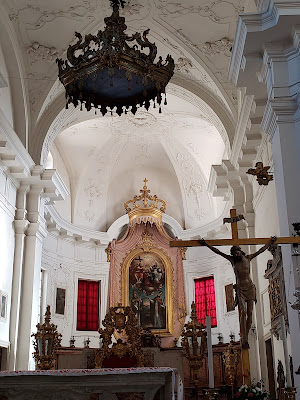
The Cathedral of the Assumption of the Blessed Virgin Mary stands in the same location once occupied by a Roman basilica. The history of the Cathedral goes back to the 12th century, when the city acquired its own diocese. Today's front combines Gothic (the lower part) and Renaissance styles (the upper part). 


The following are some of the treasures and artwork found in the cathedral.


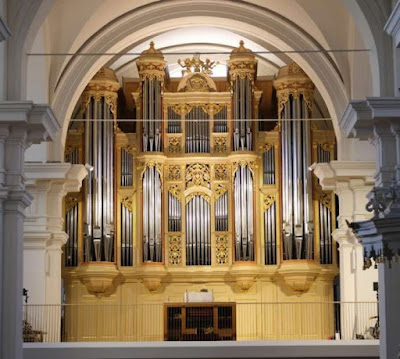
The day our ship was in port the "new" organ was being tested. The organ, which came from the famous Tonhalle concert hall in Zurich, is the second largest in Slovenia.  It weighs 16 ton and has over 5,500 pipes. 

Town tower in Tito square, was once part of a Roman fortification.  Attached to the south side of the Cathedral, it became a bell tower between the 15th and 17th centuries. It houses one of the oldest bells in Slovenia, dating back to 1333. After climbing it's 204 steps, you have a panoramic view of the city Koper.

The Cathedral and Bell Tower are in Tito Square along with other historic buildings...

and Da Ponte Fountain which acquired its current Baroque appearance in 1666, when podestá Lorenzo Da Ponte had it rebuilt. The octagonal fountain pool with an arch is further decorated with pyramids, coats-of-arms, stone faces, other motives and a fence.  The fountain was used until 1898. 


At the southern end of Prešernov trg is the Muda Gate. Erected in 1516, it's the last of a dozen such entrances to remain standing. On the south side of the archway you'll see the city seal: the face of a youth in a sunburst.


Along with every other town along the Adriatic, Venetian influences are everywhere.  You know its Venetian when you see the Venetian Lion.  St Mark's Lion, also called the Venetian lion normally has wings, very often holds a book below its paw, and sometimes is completed by a halo around its head. These three elements (wings, book, halo) reveal it as a symbol of Saint Mark the Evangelist, patron saint of the city of Venice.

The street leading to Tito Square has some of the historic homes whose second story projected out over the street.  This one has a very interesting paint pattern. 

Saturday, November 27, 2021

Krka National Park, Croatia

I started the day riding in a bus for over an hour so I saw some of the Croatia countryside.  There weren't a lot of people in the rural areas. 


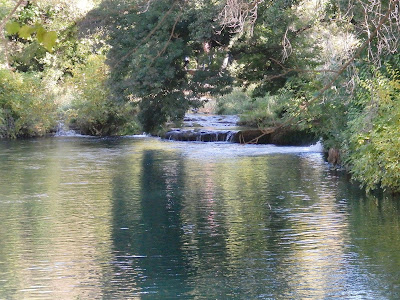
The Krka River which creates the beautiful landscape to which we were headed. 

This photo shows both the arid karst landscape of prickly bushes and the stone walls we saw dotting the land. These walls are called suhozid (dry-stone wall, in singular) or suhozidi (dry-stone walls, in plural).  People used this technique to protect their land and plant species from harsh weather.


Finally we arrived at Krka National Park.

But we weren't to our destination yet. First we descended hundreds of feet to water level. 

Down a very curvy road. 
 
  Double click to enlarge for reading.

You will have to double click to see the yellow line that represents the trail that we walked around the waterfall. The Skradinski buk waterfall biological and geological trail is 1.2 miles long with a couple hundred foot of elevation loss going down only to climb back up on the other side. 


Double click to enlarge for reading 


The cascades are composed of travertine barriers, islands, and lakes. They can be viewed throughout the entire year thanks to a network of paths and bridges.

Several renovated water mills, rolling mills, and washing columns that for centuries have utilized the power of the river are also located at the Skradinski buk. Preserving the traditional folk architecture, some individual mills have been turned into souvenir shops, while others have been transformed into exhibition areas for ethnographic collections.

These ducks are having a nice rest on a log. 


Several small bridges connect the water mills.


Grain hauling wagon

The watermills on Skradinski buk waterfall are a preindustrial complex that once milled wheat for the whole of Dalmatia. The Dalmatian chrysanthemum is a plant that was milled at the mills of the Šupuk family at Skradinski buk waterfall, and it was used as an insecticide during the digging of the Panama Canal


Since we were at the park in the fall, the water level was really low. 


All dry here.


This sun lit spot in the clear water contained some fish 


There are numerous large fig trees in Krka National Park. Figs originated in the Mediterranean area. Some of the trees produce huge figs. The fig trees grow both in water and on land. They are easy to spot all along boardwalk path.


Travertine ledge missing its water. 

Click to enlarge 

Little purple flowers everywhere. 


About 1/2 way into our walk we came across a picnic area.  Displays explaining the various animal and plant life of the area surrounded it. 


The trail became less level boardwalk and more stairs. 


Finally we made it to the foot of the falls. 

The combined waters of the Krka and Čikola Rivers spill together over the 17 steps of Skradinski buk waterfall, spread over a length of 2600 feet. The waterfall is 650 to 1300 feet wide, with a total elevation difference of 150 feet. Most of the foam that you can see under the falls on Skradinski buk waterfall is, in fact, natural soap.


This overhead view gives you a better idea of the area we were in.


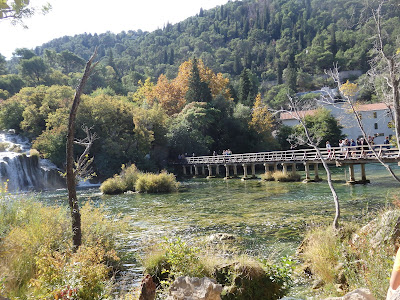
This view from the bridge shows just how shallow the water is in places. 

Yep, only an inch deep here. 


After the bridge we started climbing up the hillside.  This is a part from the Krka Hydroelectric plant. 

 The Krka Hydroelectric Plant, the world's first hydropower plant to power a city - Šibenik


After the park, we headed off to Skradin. 

Passing over the river again. 

The restaurant in Skradin where we ate.  There were three busloads of people eating all at once.  No choice on the food.  You ate what they put in front of you. 

View of the tollbooths to enter the road we were on. 

Tucked into the side of this canyon is the remains of the Utvrda Kličevica fortress.  Just the walls remain.